Registered User?
Login
(or)
Role‑plays, email drills, meeting practice, and negotiation language — coached by AI with instant feedback, designed for teams and professionals worldwide.
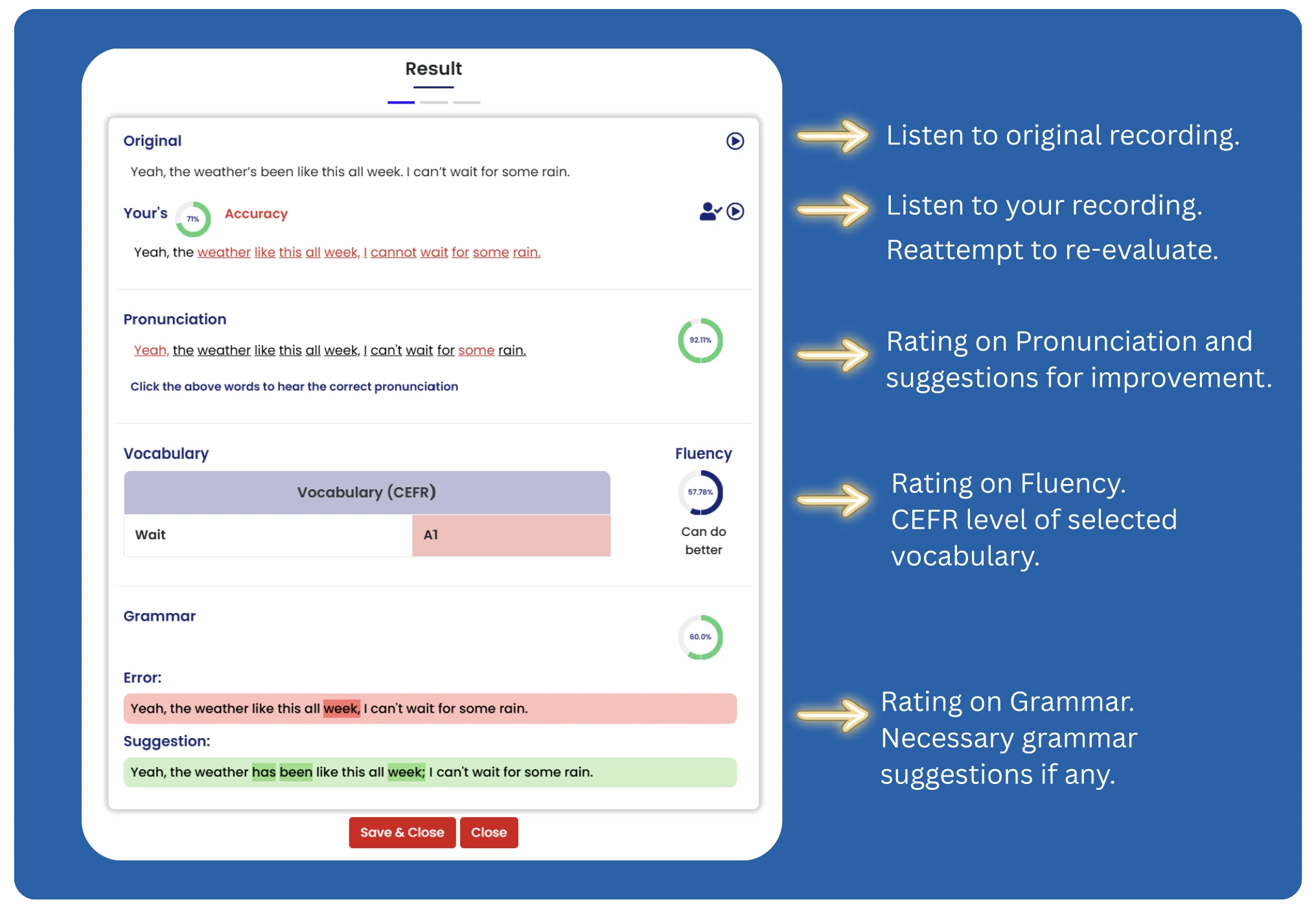
The Spoken English Speech Buddy program is designed to help learners build confidence and fluency in everyday communication through structured, theme-based conversational practice.
It follows the European Framework of Reference for Languages (CEFR), progressing from A1 (Beginner) to C2 (Proficient), with each level providing real-world speaking opportunities aligned with the learner’s linguistic development.
The curriculum is built around 10 key communication themes, each containing 5 real-life conversation scenarios per level.
This ensures that students move from basic everyday exchanges to complex social and cultural communication, while continuously improving pronunciation, grammar, and fluency through AI-supported feedback.
| CEFR Level | Learning Stage | Theme Approach | Skill Development Focus |
|---|---|---|---|
| A1 – Beginner | Learners begin to use simple expressions and basic interactions | Common foundational themes | Everyday communication, basic self-expression |
| A2 – Elementary | Learners expand on familiar topics with growing vocabulary | Same themes as A1 with broader vocabulary | Describing routines, people, preferences |
| B1 – Intermediate | Learners communicate independently in familiar contexts | Continuation of same themes with higher linguistic demand | Narrating experiences, expressing opinions, polite interaction |
| B2 – Upper Intermediate | Learners can discuss abstract and unfamiliar topics with fluency | Introduction of new, advanced themes | Debates, expressing viewpoints, managing discussions |
| C1 – Advanced | Learners use language flexibly for social, academic, and professional purposes | New, complex and cognitive themes | Persuasive communication, interpreting meaning, advanced discourse |
| C2 – Proficient | Learners communicate with mastery and cultural appropriateness | Entirely new themes reflecting global and abstract ideas | Leadership communication, cultural reflection, social analysis |
Six levels mapped to CEFR with 10 themes each — focusing on business scenarios, tone control, and cross‑cultural clarity.
At the foundational stages, learners are still developing linguistic confidence and communicative competence.
Keeping the same set of themes for A1, A2, and B1 serves several instructional and cognitive purposes:
| Theme | A1 Focus | A2 Focus | B1 Focus |
|---|---|---|---|
| Introductions | Saying hello and introducing oneself | Describing yourself and your family | Talking about your experiences or background |
| Daily Life | Describing your day | Talking about routines and habits | Discussing lifestyle and time management |
| Travel | Asking for directions | Booking a ticket or hotel | Sharing travel experiences and recommendations |
This repetition-with-progression model is pedagogically aligned with Vygotsky’s Zone of Proximal Development — allowing students to build upon existing schema (familiar topics) while increasing linguistic challenge.
From B2 onward, learners move beyond routine communication into conceptual, analytical, and expressive use of English.
Here, entirely new and cognitively rich themes are introduced to enable complex thinking and cultural expression.
This thematic evolution mirrors the CEFR descriptor shift — from functional accuracy to discourse competence and sociolinguistic sophistication.
The design reflects the CLT methodology, ensuring learners:
Levels & their Key Outcomes: