
English is often described as a rich and flexible language and one of the main reasons for this is its long history of borrowing words from many cultures around the world. From daily conversation to academic writing, from food to science, borrowed words quietly fill our vocabulary and shape the way we think and communicate. The English we use today is not the product of a single culture. It is a mosaic built over centuries of contact, trade, conquest, migration and learning. This blend gives English both its charm and its complexity.
The story of English begins in the early medieval period when the language was shaped by Germanic tribes who settled in Britain. But as soon as these early speakers came into contact with new cultures their vocabulary grew. Over time English borrowed thousands of words and today nearly seventy percent of English vocabulary has foreign origins. Understanding this history helps us appreciate the language more deeply and opens doors to learning new words with confidence.
Why English Borrows So Many Words
English is incredibly open to new vocabulary for many reasons. One reason is historical. Britain was invaded and ruled by different groups such as the Vikings and the Normans. Each new group brought its own language and left its influence on vocabulary. Another reason is cultural exchange. As the British travelled, traded and built relationships with people across continents they absorbed new ideas along with new words. English speaking scholars also borrowed heavily from classical languages like Latin and Greek for academic and scientific terms.
Another reason is the flexible nature of English itself. English speakers accept new words easily and rarely worry about protecting the language from outside influence. This open attitude makes English a constantly growing language that can describe new inventions, foods, discoveries and feelings with ease.
Words Borrowed from French
One of the biggest influences on English came from French. After the Norman Conquest in 1066 French became the language of the ruling class in Britain for several centuries. As a result many English words for law, government, cooking and fashion come from French.
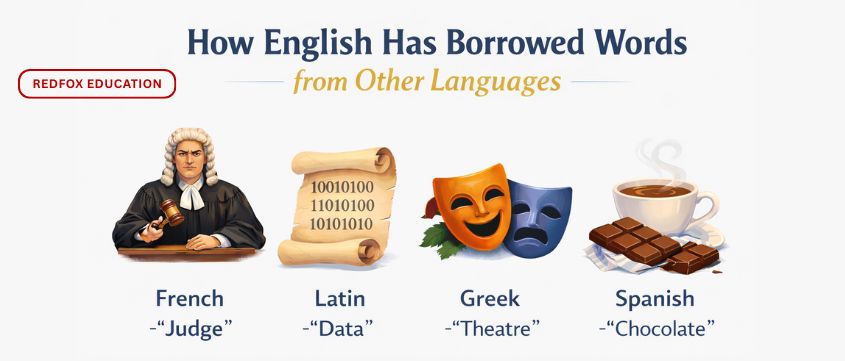
Words like judge, court, jury, government, beauty and perfume entered English during this period. Even simple words like very, use and change came from French. When you enjoy dishes such as beef, pork or mutton you are using names that arrived through French. The cooking vocabulary of English is filled with French words such as cuisine, restaurant and menu. This is why modern English has a mix of simple everyday words of Germanic origin and more elegant sounding words of French origin.
Words Borrowed from Latin
Latin influenced English long before the Normans. When Christian missionaries arrived in Britain they brought Latin religious terms. Later during the Renaissance period scholars revived interest in Latin learning and imported many academic and scientific words. Today subjects like medicine, astronomy, biology and law use Latin inspired terms.
Words like data, radius, campus, species, formula and library are everyday examples. Latin roots also form the base of countless English words like educate, construct, involve and manual. Even though English is not a Romance language its vocabulary has a strong Latin foundation which makes it easier to learn many European languages.
Words Borrowed from Greek
Greek entered English mainly through scientific and academic fields. As scholars studied mathematics, philosophy, medicine and the natural world they relied on Greek vocabulary to name new ideas.
Words like theatre, music, physics, democracy, geography and problem all have Greek origins. Modern science still uses Greek roots such as micro, photo, tele and bio. When you say microscope, telephone or biology you are using small pieces of Greek that travelled across centuries into modern English.
Words Borrowed from Indian Languages
English also absorbed many words from India during the period of British rule. When the British encountered new foods, animals, fabrics and cultural ideas they adopted local names because no English words existed for them.
Familiar words such as chutney, curry, bungalow, jungle, shawl and veranda came from Indian languages. Even the word shampoo is from a Hindi word that means to press or massage. Everyday words like bazaar, loot and pyjama also have Indian origins. This influence shows how English grows whenever it meets new cultures and lifestyles.
Words Borrowed from Chinese and Other Asian Languages
Trade with East Asia brought new vocabulary into English as well. Words like tea, gong, ketchup and typhoon came from Chinese or nearby regions. The name for the game chess came from a Persian word while words like safari and sofa came from Arabic. From Japan English borrowed words such as sushi, karate, kimono and tsunami. Each borrowed word carries a piece of its original culture and enriches English by adding new sounds and ideas.
Words Borrowed from Spanish and Italian
Exploration and trade with southern Europe also left strong marks on English. Many words for music, art and food come from Italian. These include piano, opera, balcony and spaghetti. The influence of Spanish brought words like tomato, chocolate, potato, tobacco and mosquito through early contact with the Americas. Many sport terms such as rodeo and ranch also came from Spanish.
How Borrowed Words Help English Grow
Borrowed words expand not just vocabulary but also cultural understanding. When English adopts words from other languages it also adopts the experiences, inventions and emotions of the people who created those words. This makes English a global language that can adapt to new concepts quickly.
For example, modern technology introduces words from everywhere. Software terms like emoji came from Japanese. Food terms like hummus and falafel gained popularity with cultural exchange. English also borrows phrases directly when it needs to express a new idea clearly. This openness keeps English alive and evolving.
Borrowed Words in Everyday Life
If you look closely, almost every sentence in modern English contains words that came from other languages. A simple sentence like I bought a pizza for lunch uses words from Germanic, Latin and Italian origins. English speakers may not realise this because the language has blended these words so smoothly over time. The mix gives English variety and richness that few other languages can match.
The Future of Borrowing in English
English will continue to borrow words as the world becomes more connected. New discoveries, global travel, online communication and cultural exchange introduce fresh vocabulary every day. As societies change and new ideas appear English will find new ways to describe them. Borrowing will remain a natural part of this growth.
Conclusion
The history of English is the history of borrowing. Every wave of contact with other cultures added something new to its vocabulary. This process made English expressive, adaptable and global. When you speak English you are speaking a language built by people across continents and centuries. Understanding how borrowed words shaped English not only deepens your appreciation but also helps you learn the language with greater curiosity and confidence.
Get unlimited access to our Premium products with Red Fox Education's English courses, designed to give you the language skills and confidence needed to hold conversations in spoken English on a variety of topics.
If you still don't have the Red Fox Education mobile app download it.
 |
 |
Feb 10, 2026 | Vocabulary | No Comments