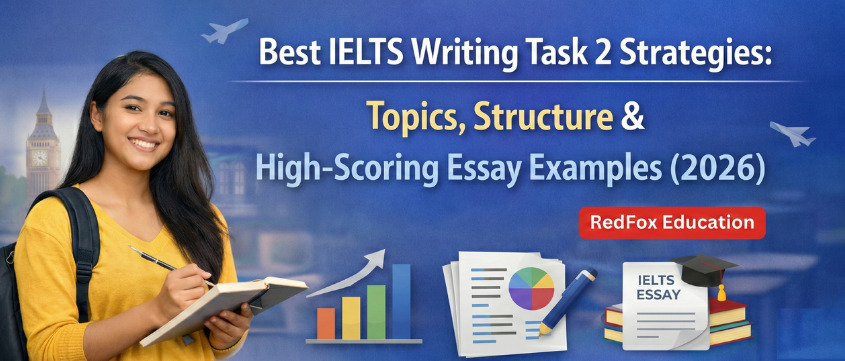

If you are preparing for IELTS Writing, you already know that IELTS Writing Task 2 is the real game changer. It carries more weight than Task 1, and for many students, it is the difference between Band 6.5 and Band 8.
The good news? IELTS essay writing is not about talent. It is about strategy, structure, and clarity.
In this complete IELTS Writing Task 2 guide for 2026, you will learn updated essay strategies, common question patterns, band descriptors, and practical writing techniques used by Band 8 and Band 9 candidates.
If you want structured training, detailed feedback on your essays, and proven band improvement techniques, you can explore our complete IELTS course packages here:
https://redfoxeducation.com/ielts-course-packages
Now let’s break down exactly how to approach IELTS Writing Task 2 in 2026.
What is IELTS Writing Task 2?
In IELTS Academic Writing Task 2, you must write a formal essay of at least 250 words in 40 minutes.
IELTS Writing Task 2 is part of both IELTS Academic and IELTS General Training exams, and it contributes approximately 66% of your total Writing band score.
This task tests your ability to present arguments clearly, organise ideas logically, support opinions with relevant examples, and use strong vocabulary and grammar accurately.
Your IELTS Writing band score is based on four criteria:
Task Response
Coherence and Cohesion
Lexical Resource
Grammatical Range and Accuracy
Understanding the IELTS Writing band descriptors is crucial if you want to move from Band 6 to Band 7 or Band 8.
Since Task 2 contributes two thirds of your total Writing score, smart IELTS Writing preparation is essential.
IELTS Writing Task 2 Topics 2026
While questions change, the themes remain similar every year. Most IELTS Task 2 topics fall into areas such as:
Education
Technology
Environment
Health
Crime and punishment
Government spending
Globalisation
Social issues
Recent IELTS Writing Task 2 questions in 2025 and 2026 show increasing focus on the societal impact of technology (AI, social media), environmental sustainability, modern work-life dynamics, and healthcare. Topics also heavily feature education shifts, urbanization, and ethical debates on, for example, remote work and data privacy.
Instead of memorising essays, focus on building flexible ideas that can be adapted to multiple topics. This is one of the best IELTS Writing strategies used by Band 8 and Band 9 students.
Understanding IELTS Essay TypesBefore you write anything, identify the type of essay. This changes your structure completely.
The main IELTS Writing Task 2 types are:
Opinion essays
Discussion essays
Problem solution essays
Advantages and disadvantages essays
Direct question essays
Many IELTS candidates search for “IELTS opinion essay structure,” “IELTS problem solution essay format,” and “IELTS discussion essay examples,” so understanding these formats clearly gives you a scoring advantage.
Many students lose marks simply because they misunderstand the question. Learning how to analyse essay types properly can dramatically improve your IELTS Writing band score.
IELTS Writing Task 2 Structure ExplainedA strong IELTS essay structure makes your writing clear and easy to follow.
Introduction
Paraphrase the question and clearly state your position or outline what the essay will discuss.
Body Paragraph One
Present your first main idea. Explain it clearly. Support it with an example.
Body Paragraph Two
Present your second main idea. Develop it logically and provide an example.
Conclusion
Summarise your key ideas and restate your opinion if required.
Simple structure. Clear development. No overcomplicating.
This four paragraph IELTS essay structure is widely recommended by experienced IELTS trainers because it improves coherence and cohesion naturally.
If you struggle with organising ideas or writing clear thesis statements, guided practice with expert correction can make a huge difference. Our IELTS Writing programmes focus heavily on essay structure and personalised feedback. You can check the details here:
https://redfoxeducation.com/ielts-course-packages
Opinion essays are one of the most common formats.
To score Band 8 or higher:
State your opinion clearly in the introduction
Do not change your position halfway
Develop each paragraph fully instead of listing points
Support arguments with logical explanations
Avoid extreme or emotional language
High scoring IELTS essays always demonstrate clear topic sentences, logical progression of ideas, and relevant real world examples.
Examiners are not impressed by complex vocabulary alone. They reward clarity and depth of argument.
Band 8 and Band 9 Essay ExampleQuestion:
Some people believe university education should be free for everyone. To what extent do you agree or disagree?
Sample response style:
In recent years, there has been considerable debate about whether higher education should be provided free of charge to all students. While free education may promote equality of opportunity, I believe a partially funded system is more sustainable in the long term.
Supporters of free university education argue that it allows students from disadvantaged backgrounds to access better career opportunities. Without financial barriers, talented individuals can pursue academic goals regardless of their economic situation. This can contribute to social mobility and national development.
However, fully government funded education would require substantial public spending. Allocating such large budgets to universities may reduce funding for essential services like healthcare and infrastructure. A balanced system where students contribute partially through tuition or income based repayment schemes may ensure both accessibility and financial sustainability.
In conclusion, although free higher education offers social benefits, a shared financial responsibility model appears more realistic and practical.
Notice the clarity. No memorised templates. No overcomplicated language. Just strong, logical development.
IELTS Writing Task 2 Vocabulary for Higher BandsStrong vocabulary improves your IELTS Writing score, but it must sound natural.
Instead of basic phrases, try:
There is growing concern that
It is widely believed that
One significant factor is
This can be attributed to
A key advantage is
In the long term
Using topic specific vocabulary related to education, technology, environment, and social development can significantly increase your Lexical Resource band score.
Avoid forcing complex words into sentences. Accuracy always matters more than difficulty.
Common Mistakes in IELTS Writing Task 2Many students lose easy marks because they:
Write under 250 words
Do not answer all parts of the question
Repeat ideas in different words
Use informal language
Fail to develop ideas properly
Memorise templates that sound unnatural
Another common mistake in IELTS Writing Task 2 is poor time management, where students spend too long planning and leave insufficient time for proofreading.
Regular IELTS Writing practice with expert feedback helps you identify and correct these mistakes quickly.
Want step-by-step guidance and essay correction? Check our IELTS Writing Task 2 self-study course:Scoring Band 8 or 9 is not about writing complicated essays. It is about:
Understanding the question fully
Planning before writing
Developing ideas clearly
Using varied but accurate vocabulary
Maintaining grammatical control
Managing time effectively
Practising IELTS Writing Task 2 sample questions under exam conditions is one of the fastest ways to improve your writing confidence and band score.
With consistent practice and the right strategy, high scores are absolutely achievable.
IELTS Writing Task 2 can feel intimidating at first, but once you understand the structure and learn how to build strong arguments, it becomes much more manageable.
Focus on clarity. Focus on structure. Focus on idea development.
Whether you are targeting IELTS Band 7 for university admission or Band 8 for immigration purposes, structured IELTS Writing preparation can significantly improve your overall score.
Check our complete IELTS Writing Task 1 guide with Band 9 sample answers and graph interpretation tips:
 |
 |
Mar 04, 2026 | IELTS | No Comments